Thai Massage for Drivers in Greenock
Most people think driving is a passive occupation. Drivers know otherwise. Long hours at the wheel create a very particular physical toll: hips held in sustained flexion, the lumbar spine loaded from below, upper traps bracing against every vibration that travels up through the seat, and a neck rotating left, right, left again all day for mirror checks. That is the driver’s slump, and it accumulates in a way that getting out at a services for a stretch never quite unwinds.
The reason is straightforward. A roadside stretch releases surface tension but leaves the deep compression pattern intact. After eight or ten hours in the same seat, the hip flexors, piriformis, and lumbar structures have adapted to that position.
They need to be held open from the outside while the muscle releases: someone creating space in the joint, not just asking you to reach for your toes. That is exactly what the assisted stretching in Thai massage is designed to do, and it is why drivers who book at Serendipity Thai Massage Greenock often describe the result as qualitatively different from anything they have tried before.
Whether you drive a taxi through Greenock’s town centre, run deliveries across Inverclyde, or take HGV runs along the Clyde corridor, the pattern is recognisable: right hip higher and tighter than the left from years of foot-on-pedal asymmetry, lower back stiffening within the first hour of a shift, and a neck that aches by the end of the run from constant mirror work. Book online and Jariya will work on that specific pattern rather than a generic back-and-shoulder routine.
Why Traditional Thai Massage Works for Professional Drivers
What Jariya notices most with driving clients is that the restriction is rarely where they feel it. A driver arrives pointing to the lower back — the most commonly reported musculoskeletal complaint in transport work, according to the Health and Safety Executive. The real lock is in the hip flexor and the piriformis: the deep gluteal muscle that sits against the sciatic nerve and gets compressed against a seat for hours at a stretch.
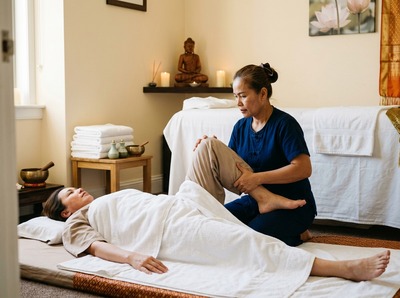
The standard advice for driving-related back pain is to stretch more and pay attention to posture. Neither is wrong. In Jariya’s experience, though, drivers who have followed that advice conscientiously for months are often the most surprised to find the real restriction is two joints away from where they feel it. Working the lower back alone gives temporary relief. Working the hip complex, releasing the piriformis, and letting the pelvis return to neutral means the lower back often releases without needing to be directly targeted at all.
Traditional Thai Massage treats the whole kinetic chain rather than isolated symptoms. Jariya trained at Bangkok’s Wat Po temple, where the technique centres on tracing tension along connected pathways. For drivers, that includes the cervical restriction that builds from hours of mirror-checking rotations on top of an already forward-loaded neck posture.
Those two things compound each other: the mirror-checking fatigue sits on top of the static strain, and addressing only one of them is why some treatment approaches never fully clear the neck. Working the full sequence, from foot through hip through lumbar through cervical, is what makes the relief hold through the next shift rather than fading before you reach the depot.
Marcus, a client who had carried lower back pain for years, described his first session as working out all the knots and leaving him “relaxed and rejuvenated.” That response is consistent with what Jariya sees in clients whose bodies have been held in one position for long periods without adequate release.
What to Book: Treatments for Taxi, Delivery and HGV Drivers
The sessions most useful for driving-related tension are:
- Traditional Thai Massage — fully clothed, mat-based work using acupressure and assisted stretching along the body’s energy lines. For drivers, the hip flexor and lower back work here reaches positions you cannot get to by stretching alone. This is the core treatment for the driver’s compression pattern.
- Thai Sports Massage — targeted recovery work on specific muscle groups. Particularly useful for right-side hip, glute and upper trap tension that builds from a fixed steering position over a long run.
- Thai Foot Massage — reflexology-based work on the foot and lower leg, including the calf and soleus. Relevant for any driver whose right leg and foot carry repetitive pedal load through a shift.
- Thai Oil Massage — flowing oil-based work along the full length of the spine, suited to the background stiffness that builds during long motorway runs or multi-stop delivery routes.
Booking Thai Massage Therapy Around Your Schedule
Serendipity Thai Massage Greenock is at 54 Kelly Street in Greenock, a short walk from the town centre and straightforward to reach whether you are based in Greenock, Gourock, Port Glasgow or further along the Inverclyde coast.
Sessions are booked by appointment, so you can plan around your working pattern, an early start before a run or a wind-down after the last drop. Book your appointment online or call 01475 600868. Your first visit includes a short conversation about what you are carrying; each subsequent session builds on the previous one.
Trusted by Clients Across Inverclyde
Jariya personally delivers every session at Serendipity Thai Massage Greenock and keeps detailed notes from each visit. Treatment evolves with your body over time rather than repeating the same routine at each appointment. For drivers dealing with a tension pattern that has built over months or years, that continuity matters: progress is cumulative, and regular sessions prevent the restriction from re-establishing itself between appointments.
Her Wat Po training gives Jariya a specific framework for understanding how postural compression develops, not just which muscles are tight but why they have adapted that way and which part of the chain to address first. Drivers who have tried other approaches without lasting results often find that treating the full pattern from foot to hip to lower back to neck produces a different outcome.