How often should you get a Thai massage in Greenock
How often should you get a Thai massage in Greenock
The right frequency for a Thai massage depends on your goal: weekly during an acute flare, fortnightly for an ache that keeps coming back, and monthly to maintain. I’m Jariya Malone. I trained at Wat Po in Bangkok and I treat people on Kelly Street in Greenock, and I plan every client’s spacing around what they are trying to fix, not a single number.
Most online advice gives one figure for all massage. At Thai Massage Greenock, we think that misses a real difference: traditional Thai massage combines acupressure with assisted stretching, so your body recovers from it differently than from an oil massage.
Weekly: the acute flare
If you have a flare such as sciatica or a frozen shoulder, I’d normally see you weekly for the first few sessions. Sciatica needs a GP’s opinion first, and I’ll always ask what has been checked. If that sounds like you, get in touch to book your appointment and we’ll plan those first weeks together.
Closer spacing works because an acute problem needs repeated, gentle input before it settles. A study in the Journal of Thai Traditional and Alternative Medicine on Nuad Thai for shoulder pain found the optimal number of sessions depended on how bad the pain was beforehand, between two and four. That fits what I see: the worse the starting point, the more sessions it takes to move.
In our experience, the mistake people make in a flare is waiting a month between visits. By then the area has tightened again and we are starting from the beginning. A week apart, each session picks up where the last one stopped.
I had a client seeing a physiotherapist for shoulder pain who wasn’t progressing. The restriction turned out to sit in the upper back, not the shoulder. We worked on that pattern consistently, and their physio sessions became much more effective.
They now do both.
Fortnightly: desk tension and the ache that keeps returning
An ache that returns after every good session, in the neck, shoulders, lower back or knees, suits fortnightly sessions. This is the pattern I see most in people who book with me, and it is where the work compounds.
In my experience, this is usually desk tension. A lot of people in Inverclyde sit on the train or the M8 to Glasgow, then at a screen all day. The neck and shoulders loosen after a session, then tighten again over the next two working weeks.

Fortnightly catches it before it locks back in.
We’ve seen clients who try to stretch that gap to six weeks because they feel fine at week three. Most of them are back at week five with the same stiff neck. Two weeks is not a rule from a textbook. It is roughly how long the benefit holds when the desk, the commute and the screen have not changed.
One review on our page described “two knots on the right side of my back that had been bothering me for two months.” Knots like that usually go quiet after the first session and come back if you stop. Fortnightly spacing gives the tissue time to settle while the stretching work keeps building range of motion.
I’d plan four to six fortnightly sessions, then reassess. The evidence for massage on back pain is modest. NICE guidance positions it as part of a package that includes exercise, so I give you stretches to keep doing between visits.
Monthly: maintenance and general wellbeing
Once you feel better, monthly is enough for most people. The common advice is to come back when it hurts again. In my experience, that misses the point.

I’ve noticed that clients who come regularly, even once a month, progress faster than those who only appear in a crisis. Your body remembers the last session, and each one builds on it. I keep notes on every client, so I know what we found last time and where to start.
It isn’t like a haircut where every appointment stands alone. The cumulative effect is the point.
Monthly also suits people who come for stress or poor sleep, not a sore joint. I don’t promise that massage will cure anxiety. What I do tell people is that a body held tight all day makes it hard for the mind to switch off, and a regular session helps keep that tension from building.
Why traditional Thai recovers differently from oil massage
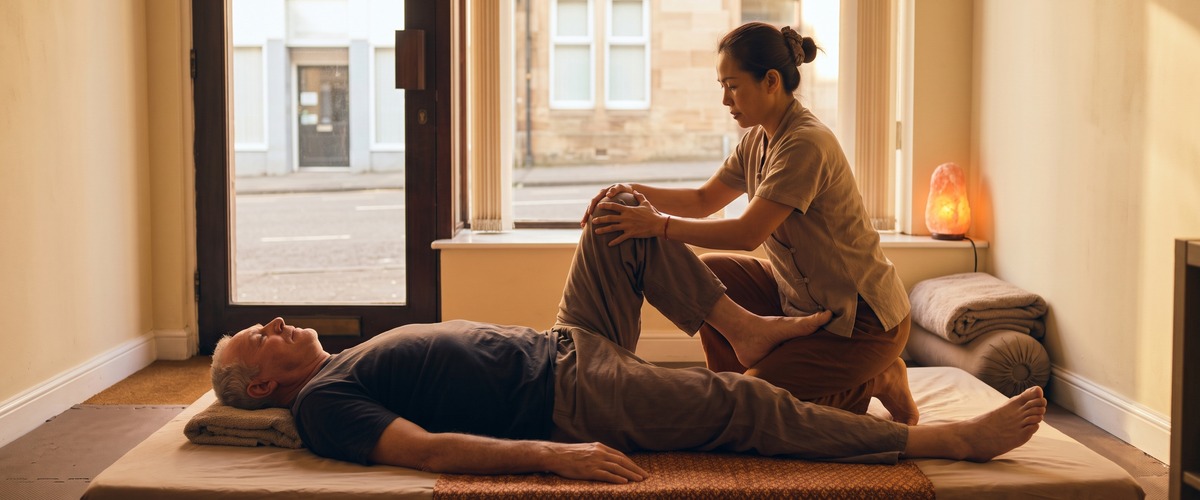
Thai Oil Massage works through flowing strokes and sustained pressure on soft tissue, so the main aftermath is muscular tiredness. Traditional Thai Massage adds assisted stretching through the joints and along the Sen lines, fully clothed on a mat. You are being moved through ranges you may not reach on your own.
A lot of first-timers arrive expecting to lie on a table the whole time. They are surprised by the mat and the stretching. By the end, they understand why: the stretching reaches restrictions that table work can’t.
What that means for spacing
After assisted stretching, your joints and connective tissue need a few days to adapt to the new range. That is why I rarely suggest more than weekly, even in a flare.
In our experience, the day after a Traditional Thai Massage feels a bit like the day after a first yoga class. Your hips and shoulders know they have been moved. After an oil session, people more often describe a heavy, sleepy tiredness that has gone by morning.

Range of motion gained from stretching fades if it isn’t repeated, which is why I plan Thai sessions as a short run, not a one-off. Oil sessions can be spaced a little more loosely once the tissue feels settled.
This is also why harder is not better. One client was convinced they needed the deepest pressure every time. Consistent, moderate work plus assisted stretching changed their neck far more, and within three months they stopped asking for it.
If you feel sore for days afterwards, we spaced it wrong or pressed too hard. You should feel released and rested, not beaten up. The Wikipedia article on massage is a fair overview if you want the wider background.
Practical advice for setting your own schedule
Start from the problem, not the calendar. Tell me which area bothers you and for how long, and I’ll suggest a run of sessions and a date to review.
- Acute flare: weekly for three to four sessions, then fortnightly.
- Desk tension or a returning ache: fortnightly for four to six sessions, then reassess.
- Maintenance and general wellbeing: monthly, ideally the same day and time each month.
Short notice can be hard in a small town, so book your next visit before you leave. Several regulars tell me they had already booked their next one on the way out, and it works. If you’ve never had Thai massage before and feel nervous, say so at the start.
I check the pressure throughout.
You can book your session online or call 01475 600868. Whether you’re coming from Gourock, Port Glasgow or the town centre, a regular slot with Thai Massage Greenock is what turns a good session into lasting change.
Found this useful? Add thaimassagegreenock.co.uk as a preferred source on Google so our latest guides show up first for you in Search and AI Overviews.