Managing lower back pain without painkillers
Most lower back pain flares are not a fresh injury. They are three days of quietly bracing against a minor twinge, and that bracing, not the original strain, is usually what tightens into the pain you are now trying to manage without painkillers.
At Thai Massage Greenock we see this pattern often. Someone tweaks their back doing something ordinary. Then they spend the next few days sitting carefully, moving less and holding their spine rigid to protect it.
By day three or four the ache has spread and the muscles feel locked. A couple of paracetamol only mute the signal. They do nothing to the guarding that is actually driving it.
This is why managing lower back pain without painkillers is less about avoiding tablets on principle. It is about catching the guarding early, before it does more damage than the original twinge ever did.
Managing lower back pain without painkillers starts with easing the guarding
Reaching for ibuprofen when your back seizes up feels like the obvious move. For a day or two it can genuinely help you get through the day.
The problem is what happens next: the muscles around a sore lower back keep bracing long after the original strain has settled. Painkillers do nothing to release that pattern.
Understanding what is happening in your back, rather than just muting the signal, is what changes the outcome. It is also exactly where a booked massage session starts to help. Book online now and we can work on the tension itself.
How muscle guarding blocks lower back pain relief
Muscle guarding is the body’s automatic response to pain. The muscles around the sore spot tighten to protect it, much the same way you flinch away from a hot pan.
A 2010 study led by van der Hulst and colleagues, published in the Clinical Journal of Pain, looked at people with chronic low back pain. It found their lumbar muscles stayed active even during simple walking, struggling to fully relax between steps.
That is the guarding reflex we mentioned above, still switched on long after it stopped being useful. Left alone for days, it becomes the tension pattern that keeps the pain going. It is why so many people find their back “just won’t loosen up” no matter how many tablets they take.
How to manage lower back pain naturally without medication
UK clinical guidance points the same way. NICE guideline NG59 on low back pain and sciatica recommends self-management and encouraging people to carry on with normal activities, alongside exercise and manual therapy, rather than treating medication as the first answer. The NHS back pain page gives the same practical advice for home use: keep moving as comfortably as you can, and use self-help measures such as heat packs early.
Alternating heat with gentle movement in the first 48 hours keeps blood flowing to tight muscles. It also stops the guarding setting in as deeply. Short, frequent walks do more for a stiff lower back than a full day on the sofa.
Back pain is not a niche complaint either. The World Health Organization reports that low back pain affected 619 million people globally in 2020, and it is the single leading cause of disability worldwide. Most of those cases are non-specific, meaning no identifiable structural culprit, which is exactly the picture where tablets alone tend to disappoint.
Massage sits alongside movement as one of the non-drug approaches guidelines actually favour, because it works on the guarded tissue directly rather than the pain signal.
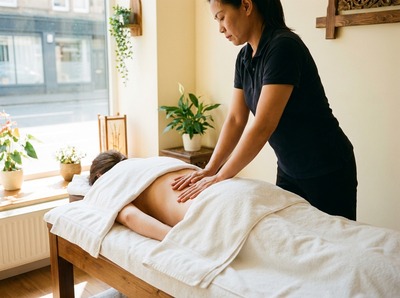
One Thai Massage Greenock client, Marcus, described years of lower back pain finally being “worked out” during his first Thai massage, leaving his body relaxed and rejuvenated. That is the guarding releasing, not just an hour of feeling pampered.
It is tempting to assume the fix is always harder pressure. Jariya, who trained at Bangkok’s Wat Po temple and treats every client at Thai Massage Greenock personally, has seen the opposite play out.
A client once arrived convinced they needed deep tissue work every visit, certain that more force meant more relief. They actually improved once sessions shifted to steady, moderate pressure with assisted stretching along the sen lines. Three months on, the tension had changed completely, and they stopped asking for the hardest pressure in the room.
The same principle applies lower down the spine. Guarded muscles need to be coaxed into releasing, not fought into submission.
If your lower back flares after sport, training or manual work, Thai Sports Massage targets that same pattern with recovery-focused technique rather than general relaxation.
How long to manage lower back pain without painkillers before seeing a doctor
Two to four weeks is a fair trial of the non-drug approaches for ordinary muscular back pain: heat, movement, massage and rest from whatever aggravated it. If it is not easing in that window, see a GP rather than push on alone.
Go sooner if you notice numbness, weakness down a leg, or any change in bladder or bowel control.
It is also worth saying that being dismissed does happen, and it is genuinely frustrating when it does. Glasgow Live reported in May 2026 on a Helensburgh woman who spent 35 years being told there was nothing wrong with her back before she finally got a diagnosis.
Persistence does not mean accepting being brushed off. It means being specific with your GP about what has and has not worked, including any bodywork you have already tried.
If you are anywhere across Inverclyde, from Gourock to Port Glasgow, regular sessions can become part of that record of what actually helps.
The tablet in the cupboard was never going to unwind three days of bracing. What resolves most lower back pain flares is the same thing that let them stick around: attention to the guarding itself.
That might mean moving earlier, applying heat sooner, or getting hands on the muscles that have quietly locked up. Managing lower back pain without painkillers is a matter of treating the tension, not just the ache. Get in touch to book your appointment and we will start with the guarding, not the symptom.
Found this useful? Add thaimassagegreenock.co.uk as a preferred source on Google so our latest guides show up first for you in Search and AI Overviews.