Massage and stress: what actually happens in your body
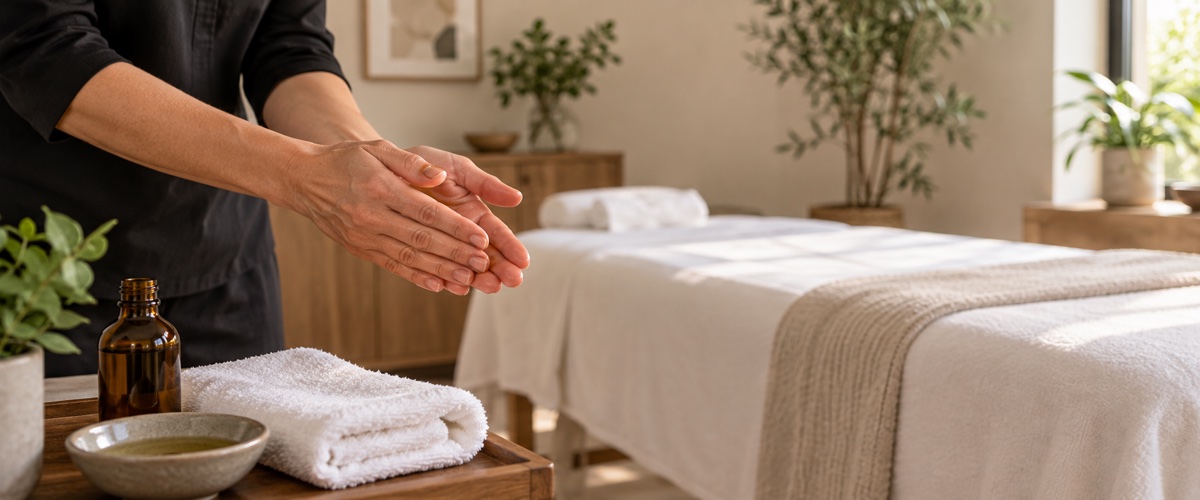
The moment you’re on the table, your nervous system starts to stand down: heart rate slows, fight-or-flight eases off. That shift is real. It’s also temporary, which is why we think of one session as a dip, not a fix.
That difference matters more than most massage marketing lets on. Plenty of places sell massage as a treat — something you book once and feel the benefit of for a week.
The evidence doesn’t back that up. What it does support is something far more useful: a process your body responds to more strongly the more consistently you keep at it.
What actually happens in your body during massage and stress relief
From the moment firm, steady pressure meets your muscles, your body starts to change gear. It moves out of fight-or-flight and into rest-and-digest. Your heart rate slows, your breathing deepens. Reversing that state, even for an hour, is a real physical event. It’s not just a nice feeling.
The cortisol dip a single session produces
The number you will see quoted everywhere is a drop in cortisol of roughly a third within a single session. A 2011 review by researcher Christopher Moyer, published in the Journal of Bodywork and Movement Therapies, went looking for the evidence behind that claim and did not find it. Massage does reduce cortisol. The reductions are simply small, and nowhere near the scale the popular figure implies.
There’s a second point worth being just as honest about. In the more carefully controlled comparison studies, that effect was smaller and less reliable still. And cortisol on its own doesn’t explain why massage helps with anxiety, low mood and pain.
Cortisol is not the only hormone that moves, either. In a Cedars-Sinai trial of healthy adults, a single 45-minute Swedish massage shifted arginine vasopressin, another hormone tied to the stress response, more than light touch did.
That honesty is useful, not discouraging. It tells you something real and measurable happens to your body in a session. It also tells you the dip isn’t the whole story, and that it doesn’t hold by itself.
If your shoulders have crept up towards your ears while you’ve been reading this, book your session today and we’ll start with what your body is actually holding onto, not a generic routine.
Why one traditional Thai massage session does not make the dip stick
This is where the usual advice falls short. Booking a single Traditional Thai Massage when you’re at your most frazzled will genuinely calm your body that day.
But your muscles don’t hold onto that relief on their own. Neither does your nervous system, unless you give it reason to. Cortisol has its own daily rhythm, so it starts creeping back that same evening. Within a day or two it’s usually close to its old baseline.
Jariya is honest about the limits of a one-off visit. “Someone once asked me if Thai massage could cure their anxiety,” she says. “I don’t promise that. What I do say, because it’s true: when your nervous system is constantly holding muscular tension, your mind struggles to switch off, even when you’re trying to.”
She sees the same pattern in clients who chase pressure instead of rhythm. “I had a client convinced they needed the deepest possible pressure every visit, because harder had to mean better,” Jariya says. “What their body actually needed was moderate, steady work across the upper back, plus assisted stretching to release what desk work had locked in. Three months of regular sessions later, their neck pain had completely changed, and they stopped asking me to press harder.”
In our experience, pressure is rarely what decides how much someone lets go. What decides it is whether the session is still and unhurried enough for the nervous system to feel safe. A body that’s braced won’t switch off, however skilled the hands are. That’s why the first ten minutes of a session are often the quietest ones. We’re not so much warming muscles up as giving your system permission to stand down.
Clients tell us the same thing in their own words. What they name first is never the technique. It’s the calm of the room and the sense that nobody’s rushing. The tension release follows from that, not the other way round.
In our experience, clients who come back regularly, even just once a month, make faster progress than people who only book when they’re in crisis. Your body remembers the work done last time, and each session builds on it. A one-off treatment stands alone.
That’s what it comes down to in practice. The dip fades on its own. But regular sessions stop your baseline tension climbing all the way back up between visits.
Sleep plays a part too. One returning client, Stephanie M., had no shoulder tightness left by the end of her session. That same night, she also had the best sleep she’d managed in a while.
That’s not a coincidence. Cortisol and sleep regulate each other. A session followed by genuinely good rest gets more out of the same treatment than one followed by another broken night.
How often should you get a massage for stress relief
Say your neck has locked up after months of desk work, or you’ve had a run of broken sleep. For a pattern like that, book weekly or fortnightly for four to six weeks. That gives your body a real chance to reset the pattern, rather than just visiting it once. After that, monthly maintenance tends to hold the gains for most people.
You can book online now whenever your schedule allows, and Jariya will talk through what pace actually fits what you are dealing with.
Not every session needs to look the same either. A Thai Aromatherapy Massage, using therapeutic-grade oils, tends to suit an evening slot before you want to sleep well.
A firmer Traditional Thai Massage, with assisted stretching along the sen energy lines, suits someone carrying physical tension from a hard week. Both work on the same stress response, just from different angles.
The regularity habit is what actually changes your baseline
Marcus, another long-standing client, first came to us after years of lower back pain. He left his first session feeling “relaxed and rejuvenated,” in his own words. That first-session feeling is genuine, and it’s also the easy part.
The harder, more valuable part is what happens over months of Thai massage and stress-reduction sessions together. That’s when your baseline tension actually shifts, rather than dipping and climbing back each time.
Locally, that shift in how people think about stress relief goes beyond one studio. Glasgow’s EQUALS wellness festival now pairs cold-water therapy with community mental health support under one banner. It treats stress reduction as an ongoing practice, not a single event.
The same logic applies to massage. It works best as a rhythm you keep up, not a treat you reach for once.
If you’re in Greenock, Gourock, Port Glasgow or anywhere else in Inverclyde, and you’ve been treating massage as an emergency reset, it’s worth a rethink. Booking on a regular cadence, even monthly, does more for your stress levels than the same number of sessions booked at random whenever things get bad.
It’s the pattern your body responds to, not just the pressure.
Takeaway: treat the dip as the start, not the finish
Massage and stress relief are genuinely connected, and the change shows up in measurements, not just in how you feel. Your nervous system settles. Your body gets a real break from the state chronic stress keeps it in.
But left on its own, that break starts fading within hours. What makes it last is good sleep afterwards, plus sessions booked often enough that your body never fully resets back to where it started.
One visit is a good beginning. A rhythm is what actually changes things.
Contact us today to book online with Jariya, and start with whatever pace suits where you are at right now.
Found this useful? Add thaimassagegreenock.co.uk as a preferred source on Google so our latest guides show up first for you in Search and AI Overviews.