Post-cruise recovery: beating travel fatigue and stiffness
The fatigue and stiffness you feel a day or two after stepping off a cruise ship is not ordinary jet lag, and treating it like ordinary jet lag is why so much post-cruise recovery advice falls flat. It is your vestibular system, the balance mechanism housed in your inner ear, working to recalibrate from days of a gently moving deck back to solid, motionless ground. That recalibration, not the travel itself, is what is driving the heavy legs, the tension across your shoulders, and the tiredness that hits harder than a normal trip home.
Most advice tells you to drink water and stretch. Both help. Neither one deals with what is going on underneath.
So people come home sure they are simply worn out. In truth, their body is still working through motion that stopped days ago.
Post-cruise recovery starts in your inner ear rather than sore muscles
Post-cruise recovery is not the same as recovery after a flight or a long drive. Your body spent days adjusting to constant, gentle motion. Once that motion stops, your brain has to learn what “still” feels like all over again.
That takes real effort, in your head and in your muscles. Most articles on cruise fatigue skip this part completely.
Sea legs recovery: why your balance system needs to reset
Sea legs recovery is really balance recovery. On board, your inner ear slowly tunes out the rocking of the ship. Within a day or two, a moving deck feels normal.
Then you step off, and that same tuning works against you. Solid ground can feel like it is still swaying.
Your nervous system is quietly working overtime to find its footing again.
That shows up as tiredness. It also shows up as tight, guarded muscles in the neck and back, long before you would think to blame your balance.
Coming home from a sailing this month? Call us now to arrange your visit to Thai Massage Greenock for a day or two after you dock, while the diary is still open.
Why generic travel-recovery advice misses the point for cruisers
People often ask whether jet lag and sea legs together make the fatigue worse. They do. If you flew or took a long coach ride home, the two stack up rather than cancel out.
One Reddit thread on r/Cruise carries that exact question in its title: how long does it take to feel normal again? That tells you the usual advice is not landing.
For Inverclyde cruisers, there is another layer. Glasgow-area passengers rarely sail from the city itself. A cruise usually starts and ends with a long coach transfer to the departure port.
That piles hours of seated stiffness on top of the balance reset. The weather change matters too.
You come home from the Mediterranean or the Canaries to Greenock’s cooler, damper air. Muscles that stayed loose and warm for a fortnight tend to seize up quickly.
Clients booking in after a cruise describe the same pattern in reviews. Tension sits in one shoulder, or travels down the back.
They are chasing a “loosen up” feeling after a demanding stretch of time. That might be a hard few months at work, or a long trip away. It is a very different brief to “I’m tired”, and it changes what a session should focus on.
Got a sailing coming up? Book your session today for the week you land, so your recovery is arranged before you even pack.
How to recover after a cruise: resetting balance before you stretch anything
How to recover after a cruise starts with a quiet first day. Give your balance system some room. Do not go straight into a hard workout or deep stretching.
Walk on flat, steady ground. Drink plenty of water. Let the wobble settle before you ask your muscles for anything demanding.
Jariya at Thai Massage Greenock makes a point that fits here exactly. Clients often assume the hardest pressure will shift the most tension.
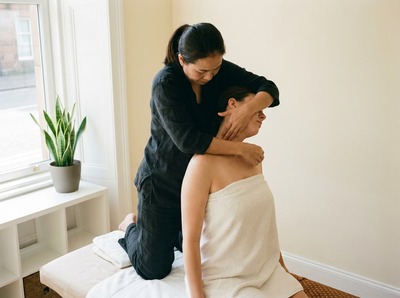
She had one client who asked for a “deep tissue” session every single visit, certain that harder meant better. What actually worked was steady, moderate pressure through the upper back, paired with assisted stretching.
Three months of regular sessions later, their neck pain had changed completely. They stopped asking for the hardest pressure possible. Tissue that is already guarding itself does not respond well to force.
From day two, a session earns its place. Deck walking and shore trips load the calves and feet hardest.
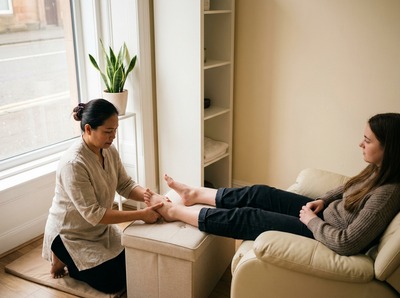
That is where Thai Foot Massage brings the most relief. It is a reflexology-based treatment working through the foot and lower leg.
Cramped cabin beds and long coach or flight legs lock up the neck, shoulders and lower back instead. Traditional Thai Massage is built to release that, using assisted stretching and acupressure along the body’s sen lines. Were you more active ashore, on hikes or long days on your feet? Thai Sports Massage does the same recovery and flexibility work used after hard training.
You do not have to wait until you feel properly rough to book in. Book online now for a day or two after you are home.
By then the wobble has settled and your body is ready for real release work. If you are coming through Greenock’s Ocean Terminal, or joining a Clyde sailing, Thai Massage Greenock on Kelly Street is an easy stop on the way.
The tiredness after a cruise is real. So is the urge to blame all of it on travel. But your balance system is doing genuine work behind the scenes, and that changes the plan.
Settle first. Stretch and book a treatment second.
Treat the stiffness as a sign your body is still catching up, not proof you need more sleep. Contact us today once you are ready for that second stage.
Found this useful? Add thaimassagegreenock.co.uk as a preferred source on Google so our latest guides show up first for you in Search and AI Overviews.