Best Stretches to Do Between Massage Appointments and When They Actually Work
The best stretches to do between massage appointments are simple, gentle movements for your neck, spine, and hips, and they work best starting the second day after your session, not the evening of. Most stretch guides skip that detail entirely. Stretch too soon after a deep tissue Thai massage and you can retrigger the very muscle guarding your therapist just spent an hour releasing.
At Serendipity Thai Massage Greenock, we see this mistake often. A client leaves feeling loose, gets home, and works through a full stretching routine that same evening because it feels productive.
The next morning, the same shoulder feels tighter than it did before the appointment. The stretch itself wasn’t wrong. The timing was.
Best Stretches to Do Between Massage Appointments Depend on Timing
This is the piece that generic stretch lists leave out. Your body doesn’t process a firm Traditional Thai Massage session, with its acupressure and assisted stretching along the sen energy lines, the same way it processes a light rest day. Deep, targeted pressure creates controlled microtrauma in tight fascia and muscle fibre, and that sets off a short inflammatory response, the same basic process behind the soreness you’d feel after an unfamiliar workout.
Stretching into freshly irritated tissue during that window doesn’t extend your massage. It can undo part of it. If you want your results to last, you can book a session online and treat what follows it as part of the treatment, not an afterthought squeezed in on the drive home.
Why a Post Massage Stretching Routine Needs a Waiting Period
Here’s a question that gets asked often but rarely answered directly: is it actually safe to stretch the same day as your massage? Mostly, yes, for light movement. Walking, gentle shoulder rolls, easy movement through your day, all of that is fine and even helpful for circulation.
What isn’t a good idea is loading a deep, held stretch onto the exact muscle group that was just worked. Your nervous system has a built-in protective mechanism called the stretch reflex, which contracts a muscle defensively when it’s pulled too far, too fast, or while it’s still irritated. Pull on inflamed tissue and you’re more likely to trigger that guarding response than to release anything.
This matters more after firmer work than lighter work. A Thai Sports Massage session, aimed at targeted recovery and injury prevention for training clients, disrupts tissue more than a gentler Thai Oil Massage does, so the waiting period matters more too.
In my experience, this is the single detail clients get wrong most. I had a client who was convinced that harder pressure every session meant better results, then went home and forced deep stretches on top of that same evening. The guarding just came straight back. What actually worked for him was moderate, consistent work on his upper back paired with assisted stretching, then holding the deeper stretches at home until the next day. Jariya adjusts what she recommends per client for exactly this reason. There isn’t one blanket rule that fits every treatment.
How Soon Should You Stretch After a Deep Tissue Massage
The honest answer follows the same curve as delayed onset muscle soreness, or DOMS, the soreness pattern researchers have tracked closely after intense physical exertion. A systematic review published via the National Library of Medicine found this soreness typically peaks between 24 and 48 hours after the tissue is worked, then gradually resolves over the following 72 to 96 hours.
Deep tissue bodywork produces a similar, milder version of that same response. So the practical rule is straightforward.
Day zero: move normally, stay hydrated, skip the deep stretch. Day two onward: your tissue has moved past the peak of that inflammatory dip, and this is when a proper stretch actually helps rather than fights your body.
Five Stretches Worth Doing Once the Window Opens
Once you’re past that first 24 to 48 hours, don’t just run a generic routine — match the stretch to the work you had done. A stretch is most useful where the treatment created new range, and most risky where the deepest pressure went. Hold each for around 20 to 30 seconds and breathe through it rather than bouncing.
- Ear-to-shoulder neck tilt — after upper-back and shoulder work: gently drop one ear toward your shoulder, letting the opposite shoulder relax down. This maintains the release around the levator scapulae without dragging on the tissue that took the firmest pressure. If your neck itself was worked deeply, give it the full 48 hours first.
- Cat-cow spine stretch — after Traditional Thai Massage: the assisted back-bends in a session take your spine through more extension than most people use in a month. On hands and knees, arch your back lifting the chest, then round it dropping your head — two minutes keeps that new movement available instead of letting desk posture reclaim it.
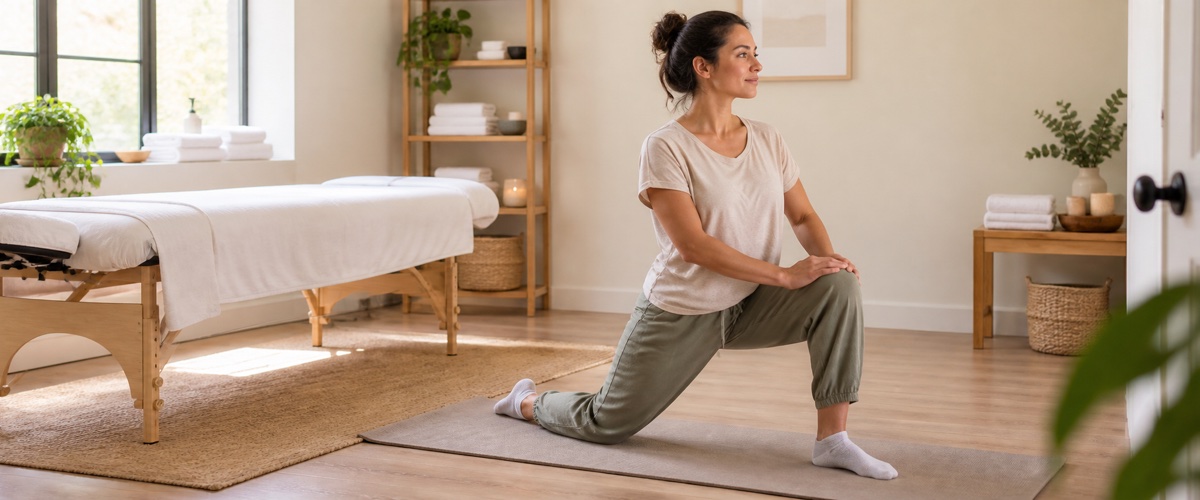
- Kneeling hip flexor lunge — after hip and lower-body work: from a low lunge with your back knee down, press your hips gently forward. Hip flexors shorten fast from sitting and driving, and they’re usually the first place a session’s gains disappear.
- Supine knee-across-body twist — for the lower back and glutes: lying on your back, guide one bent knee across your body toward the floor. This reaches the glute–lower-back junction that even hands-on work doesn’t always fully release.
- Standing forward fold — the all-rounder for the days in between: bend at the waist with knees soft and arms hanging loose, letting your spine decompress under its own weight. A short, unforced dangle loads no single muscle group, so it’s the one stretch that’s safe even inside the 48-hour window — as long as you keep it soft.
Building a Rhythm Between Appointments in Inverclyde’s Weather
Greenock’s damp, changeable weather does the same thing to hip flexors and shoulders that it does across the west of Scotland: cold, wet days keep people hunched and tense without them noticing. A short daily stretch habit does more against that pattern than one long session on a Sunday.
Jariya has noticed something specific over years of client notes: people who come in every few weeks, even just once a month, tend to make faster, steadier progress on a specific issue than people who only book when things reach crisis point. It isn’t like a haircut, where each visit stands alone. Each session builds on the last, and the stretching you do at home is what holds that progress in place between them.
That pattern shows up in what clients tell us too. One recent review described lower back pain that had built up over many years finally easing after a session, described as leaving the body “relaxed and rejuvenated.”
Another client came in specifically to prepare for a Hyrox competition, using deep tissue work as part of an active training and recovery plan rather than a one-off treat. In both cases, what happens between visits is what protects what happened in the chair.
If it’s been a while since your last visit, or you’re training for something specific and want a plan built around it, you can book your next appointment and ask Jariya what stretching schedule fits the work you had done.
The stretches themselves aren’t the hard part. Getting the timing right is.
Wait out the first 24 to 48 hours, let the tissue settle past its inflammatory dip, then build a short daily habit around the Traditional Thai Massage or Thai Sports Massage work you’ve had done. That’s the difference between a massage that fades in a week and one whose benefits are still holding by the time your next appointment comes around.
Found this useful? Add thaimassagegreenock.co.uk as a preferred source on Google so our latest guides show up first for you in Search and AI Overviews.