
Building a weekly self-care routine that actually sticks

Self-care routines tend to fall apart fast, and it’s rarely because people lack discipline. It’s because the routine was built for a version of the week that doesn’t exist: the one with a free hour every morning, an untouched Sunday afternoon, and no last-minute shift changes.
I’m Jariya Malone. I trained at Wat Po in Bangkok and I treat people on Kelly Street in Greenock, and the clients who keep their self-care habits going for months, not days, are almost never the ones with the most disciplined plan. They’re the ones who built a plan around the week they actually have.
Why a weekly self-care routine falls apart by week two
A self-care routine built for an idealised week collapses the first time real life interrupts it, and real life interrupts it almost immediately. You plan a 6am yoga session and a shift changes. You block out Sunday for a long bath and a kid gets sick.
One missed day turns into “I’ve already failed this week”, and the whole thing gets abandoned.
That’s the pattern I see constantly at Thai Massage Greenock. Clients arrive describing a self-care plan that looked great on paper: daily meditation, a morning stretch routine, an evening skincare ritual, all stacked on top of an already full week. Within a fortnight it’s gone, and they feel worse for having “failed” than if they’d never started.
The fantasy week versus the real one
The fantasy week has empty mornings and predictable evenings. The real week has a school run, a shift that overruns, a commute that eats the hour you’d planned to use. Building a routine for the fantasy week means building a routine that was never going to survive its first Tuesday.
I ask new clients one question before we talk about frequency: what does your actual Tuesday look like, not your ideal one? That single question usually reshapes the whole plan. Get in touch to book your appointment and we can work out together where a session realistically fits.
The real barrier is the first appointment, not the tenth
Here’s what surprises people. The hardest part of building a routine around massage isn’t sticking with it. It’s walking through the door the first time.
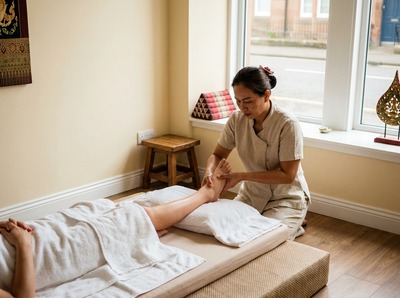
I hear a version of the same sentence most weeks: “I was a bit nervous, I’ve never had a Thai massage before.” A lot of first-timers also expect to lie on a table for an hour. When I explain that Traditional Thai Massage is done fully clothed on a mat, with acupressure and assisted stretching, they’re often taken aback. By the end of that first session they understand why.
The stretching reaches restrictions that table work simply can’t get to.
Almost nobody who gets past that first appointment struggles with the commitment afterwards. They rebook on the way out and become regulars. Several now call themselves exactly that: a regular, the same way they’d describe a standing Saturday swim at the Waterfront. If the first visit is the barrier, that’s the only thing you actually have to solve.
Designing self-care around your real schedule, not an ideal one
The fix isn’t more willpower. It’s anchoring self-care to fixed points that already exist in your week, so the routine survives even when everything around it changes. This is the same design principle that separates a habit that lasts from one that quietly disappears by month two.
Researchers studying habit formation found the median time to reach automaticity was 66 days, with individual variation ranging from 18 days to 254, according to Phillippa Lally’s habit formation study at University College London. That’s a long runway, and a routine that depends on daily perfect conditions will break long before it gets there. A routine anchored to something fixed, like a recurring appointment, has a far better chance of surviving the full stretch.
Anchor to what already exists
Rather than inventing new blocks of time, attach self-care to something that’s already fixed in your week. A desk-bound client in Port Glasgow I see fortnightly never had to “find time” for their session. It sits in the same Thursday appointment every two weeks, next to a commute they already make, so there’s nothing new to schedule around.
That’s the anchor principle at work: it doesn’t ask the rest of your week to reorganise itself. It slots into a gap that’s already there.
Shrink the routine until it fits
If your week has almost no spare capacity, the answer isn’t to force a bigger routine in. It’s to shrink the routine to something that genuinely fits. One fixed appointment a week or fortnight, plus one small daily habit you can do in under 10 minutes, beats an ambitious five-part daily ritual that gets skipped by Wednesday.
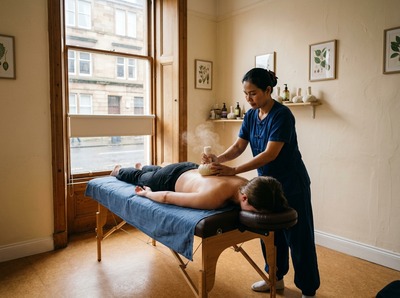
Sadie was nervous before her first Thai massage, having never tried one before. I talked her through every step and checked in on pressure throughout, and she left having booked her next session before she’d even got off the table. She didn’t build a routine that week.
She built one fixed point, and the routine grew from there.
Shift work, nursery pickup, and everything in between
Plenty of my clients work rotating shifts at the yards, in care, or in retail along the Greenock and Gourock stretch. Others are juggling nursery pickup with a full working day. A rigid daily practice was never going to fit either life.
For those clients the routine gets smaller and firmer at the same time. One 30 or 60 minute treatment booked around a known fixed point, plus something free you can do anywhere. Five minutes of stretching before bed.
A walk along the esplanade at lunch. A consistent time you go to sleep and get up. None of that costs anything, and over six or eight weeks it does more than a fortnight of enthusiasm ever did.
Pair the free daily habit with one paid anchor and you get both consistency and depth. That combination is what most people are missing.
A realistic weekly template you can actually keep
Most self-care advice gives you categories: physical, mental, social. It rarely gives you an actual week. So here’s the kind I suggest to clients who drive in from Kilmacolm or catch the train from Greenock Central into Glasgow.
It isn’t a timetable. It’s a few fixed points with plenty of slack.
- Monday: Five minutes of stretching before bed. Nothing else.
- Tuesday: A 10-minute walk at lunch, along the esplanade or round the block.
- Wednesday: Check in on one body area. Is your shoulder better or worse than last week?
- Thursday: Your anchor. A booked session every week or fortnight, same time each visit.
- Friday and Saturday: Nothing scheduled. This is your slack for when the week goes sideways.
- Sunday: A consistent bedtime to set up the week ahead.
If a day gets lost, let it go. The Thursday anchor holds the rest of the week together.
What makes a self-care habit compound instead of restart every time
A self-care routine only compounds if each session builds on the last one, which is why continuity matters more than any single technique. This is the part that gets missed when people treat massage, or any self-care practice, as a one-off treat rather than ongoing maintenance.

I keep notes on every client I see. When Stephanie came in with pain and tightness running from her shoulder down her back, I focused specifically on that area. By the end of the session there was zero tightness left, and she told me the next day she’d had the best night’s sleep she’d had in a while.
That change didn’t happen because of one perfect hour. It happened because we knew exactly what we were working on and kept working on it.
Treat tension as ongoing maintenance, not a crisis response
The common advice is to book a massage when you’re already in pain. I’d push back on that. Waiting until a problem is acute means you’re always playing catch-up, and catch-up work rarely holds.
In my own practice, the clients who come in every few weeks, even when nothing feels urgent, are usually the ones I see making steady progress on specific issues. Those who only book in a crisis tend to spend each session undoing the same tension from scratch. With regular visits, my notes from last time shape the next treatment, so the work builds rather than resets. Research supports the short-term side of this too: a randomised controlled trial on Thai foot massage and heart rate variability found that a single session produced measurable changes in stress markers. Regular sessions simply give that effect more chances to take hold.
How to tell it’s working rather than just performative
Progress shows up in specifics, not in how virtuous the routine makes you feel. Track one thing you can actually name.
My regulars do this without being asked. They’ll tell me the left shoulder is looser than last time, or that the lower back held out longer this fortnight. Many also mention how they felt the morning after, not just on the mat. That next-day check is one of the most honest markers you have.
I had a client who was certain they needed the hardest pressure possible every visit, convinced that harder meant better. What they actually needed was consistent moderate work on the upper back combined with assisted stretching to release what desk work had locked in. Three months of regular sessions later, their neck pain had genuinely changed, and they stopped asking me to go deeper.
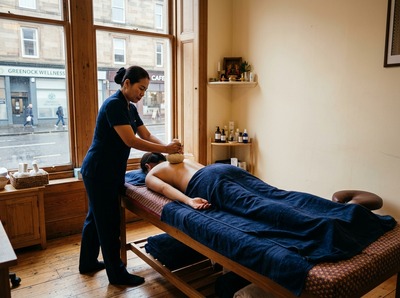
That’s a real marker. So is sleeping through the night, getting through a workday without reaching for pain relief, or noticing you’re not braced up by Wednesday.
Another client was seeing a physiotherapist for a shoulder that wasn’t improving. The real restriction turned out to be in the upper back, with postural tension radiating up. Once we worked that pattern consistently, they told me their physio sessions became far more effective.
They now do both. If you can’t name a concrete change after three or four weeks, adjust the routine rather than abandoning it.
Rebuild without starting from zero
If your routine has already fallen apart, the instinct is to rebuild the whole thing at once: new meditation app, new gym plan, new everything. That’s the fastest route back to failure. Pick the one habit that gave you the most relief before, whether that was a Sunday massage, a lunchtime walk, or a fixed bedtime, and get that single piece booked back in this week.
You can book your session online for a time that fits your actual week, not the one you wish you had. Everything else can be added back gradually once that one anchor is solid again.
The takeaway
A self-care routine that lasts isn’t the most ambitious one. It’s the one built for your real, unpredictable week rather than a version of your life that only exists in theory. Anchor it to something fixed, keep it small enough to survive a bad week, and treat it as cumulative maintenance rather than an occasional reset.
That’s true whether the anchor is a fortnightly Traditional Thai Massage on Kelly Street, a Thai Foot Massage after a long shift, or a 10-minute stretch before bed. The routine that sticks is the one that was never fighting your actual schedule in the first place.
Sources:
- Lally et al., How are habits formed: Modelling habit formation in the real world (2010)
- Immediate effects of Thai foot massage on renal blood flow, psychological stress, and heart rate variability in community-dwelling older adults: a randomized controlled trial, PMC
Found this useful? Add thaimassagegreenock.co.uk as a preferred source on Google so our latest guides show up first for you in Search and AI Overviews.